
Occupational Noise reduction through Fan Design
What is Occupational Noise and why does it matter?
Occupational noise is one of the leading hazards in the occupational safety
and health departments in industries from various sectors like thermal power,
petrochemical, cement production, mining, ventilation (HVAC), pharmaceutical
and metal industry.
Occupational noise is defined as the acoustic energy that is received by an
employee's auditory system working in the industry. Prolonged exposure to
high-intensity occupational noises can cause hearing loss. Apart from the
direct impact of hearing impairment, there are further intangible indirect
effects that can be of greater consequence in damage to the employee's health
and overall efficiency of the worker, though it may not be extremely easy to
identify.
Working load environments can affect the concentrative and cognitive
ability of the employees, hinder communication causing accidents and lead to a
decrease in the overall productivity. The psychological effects of hearing
impairment is also a considerable factor that is being studied on a global
scale.
Where is it coming from?
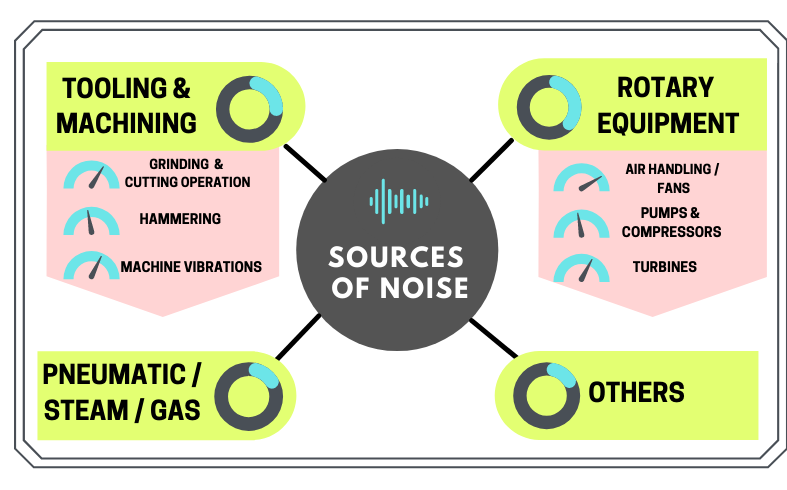
Major sources of sound in an industry originate from rotary equipment.
Among those, turbo machinery equipment, mainly air handling turbo units i.e
industrial fans are considered as the key contributors, whose operation
generally continues throughout the day. Therefore reducing the sound generated
from fans is one of the key aspects of reducing operational noise in the
industry.
The whirling vibration in all rotary shafts contributes to sound generation
in the system. Controlling the vibration by minimizing the residual unbalance,
correct bearing design and selection can help in controlling not only the noise
contribution but also increases the life of the equipment.
Various actions ranging from the elimination of the sound source,
substituting it to protecting the employees with Personal Protective Equipment
can be done to control the hazard's effect, of which, elimination or
substituting are always found to be the most effective.
Hence our primary efforts to tackle this issue should always be targeted at the source, either through elimination or substitution. As elimination is not an option in most cases, replacing or substituting the fan with a low noise model is a direct, practical and feasible method to control the noise hazard.

How do can I reduce fan noise?
The factors that control sound generated by a fan are the tip speed, number
of blades, shape and design of the aerofoil and the entire blade.
Redesign the blade by altering these factors for noise reduction leads to
major changes in the performance of the blade. To ensure the air handling
capability and performance characteristics are maintained or even improved, the
blade has to be optimised with intensive research, experimentation and
optimization process.
ENCON thus has been conducting extensive research and testing in our
in-house wind tunnel facility for the development of low noise design fans for
various operating ranges.
The new LN series axial fans have been engineered with this objective of
reducing the aerodynamic sound level of the fan while improving or maintaining
the performance efficiency under various ranges of application and design
points.